How To Use Mac Automator
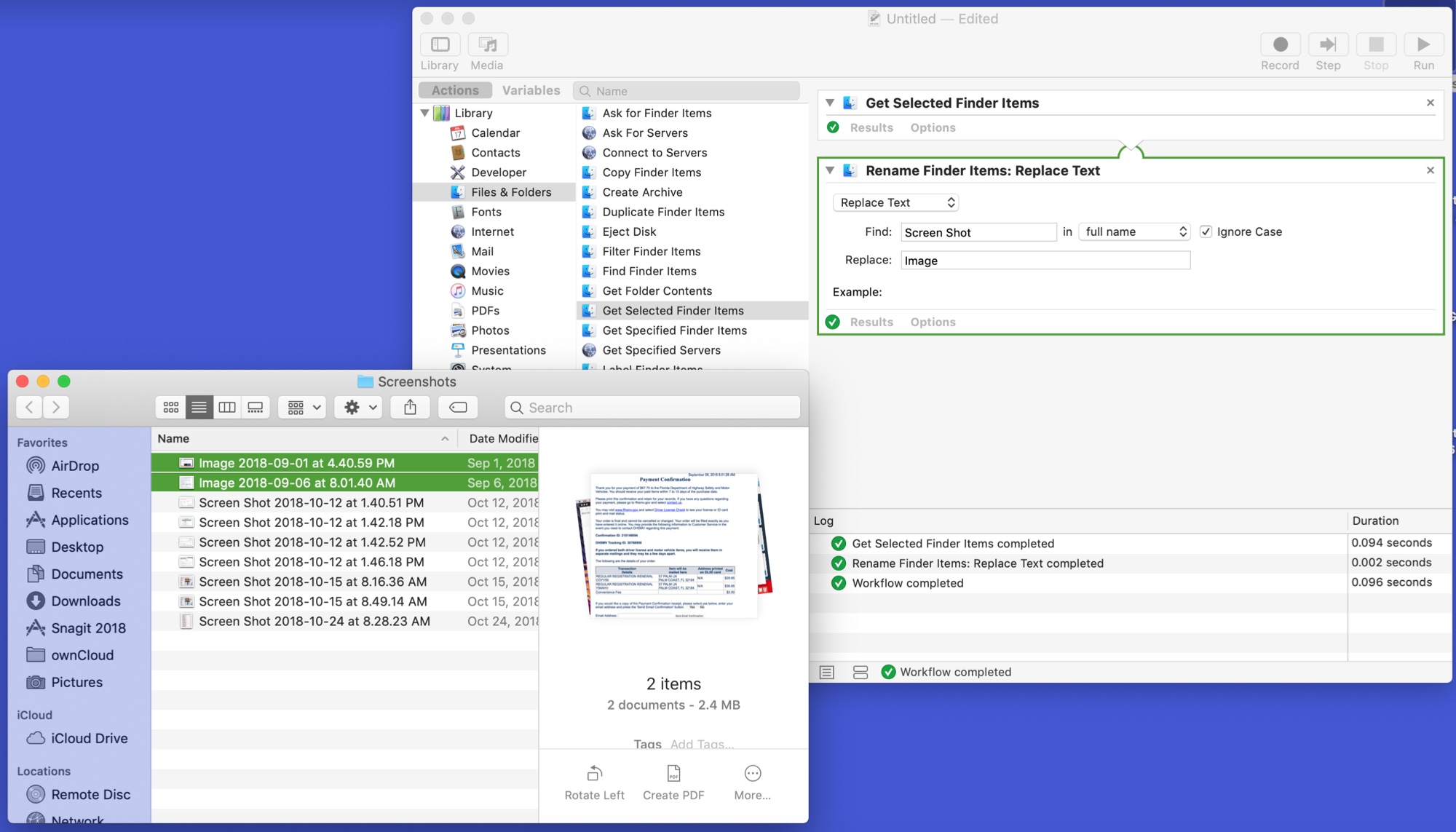
Jun 26, 2019 Automator was developed for Mac OS X. It is personnel automated resistant, and if you know how to use it,it can make your life easier. It can automate actions that could be repetitive saving you time and effort. Let show you, how to create a service workflow. You can open automator either through your application launch pad, or by clicking the. The Automator app on Mac can be used to automate a wide variety of tasks to avoid mundane routine. For instance, it can be used to create a service to rename multiple files, resize multiple. There are two ways to save a workflow. First, you can save it as a workflow. This is the default setting. Wen you open a saved workflow, it opens Automator just as it was when you saved the workflow. The other option is saving your workflow as an application. To do this, click save as from the file menu. In the file format tab, select Application. Feb 04, 2014 Well, there is – by using the app Automator that is built right into Mac OX X. In this tutorial, you will learn how to use Automator through five examples, which show you how to automate five common developer tasks: Xcode - Text Editor. How to Automate iCal on Your Mac Using Automator - Steps Open up automator and click 'custom' to indicate that you would like to create a new custom. Drag and drop the following 4 tasks into the right hand panel: Change 'new variable' in the set variable action to 'Chunk 1 name': Set the date. Perform SQL queries on an SQLite file using Automator. If you need to use a database within your app, the most likely format is SQLite. It’s light and compact, and is commonly used by Core Data. When you’re developing cross-platform apps, SQLite works great on Android. Using Automator can make managing the database more efficient.
How to Remove Automator From Chrome in OSX: Start Chrome, click —– More Tools —– Extensions. There, find the malware and select. C lick again, and proceed to Settings — Search, the fourth tab, select Manage Search Engines. Delete everything but the search engines you normally use.
Depending on your browser, the PDFs made automatically open in their own window or the download option may appear. Open Adobe Reader/Acrobat. Click on the ‘Edit’ menu then ‘Preferences’. Click on ‘Internet’ on the side bar. Under ‘Web Browser Options’ untick ‘Display PDF in browser’. Disable PDF from Opening in Web Browser (IE, Chrome, Firefox, Opera, Safari) Then click on Preferences in the drop down menu list. Click on the Internet category on the left pane. Uncheck and untick the check box for Display PDF in Browser. Click OK when done. Restart the computer. The next time you download a PDF file, it will auto open in Adobe Reader instead of IE, Chrome, Firefox, Opera, Safari or other web. Ie11 disable pdf in browser.
If you use Apple's Mail app on your Mac, you've probably had times when the application slows down. Messages in mailboxes are slow to appear; searches take longer than usual to perform. This can happen when Mail's mailboxes (or folders, if you prefer) accumulate thousands of messages — which is all the more likely if you're among the majority of the human population and you don't discard old email.
The best thing you can do is be ruthless with old email. Once you're finished with a message, move it to the trash and then empty the trash every so often. Try to think about it this way. We all receive tons of junk mail in our physical mailboxes — advertising circulars from the local supermarket, catalogs, credit card applications. If you don't save any of that stuff, why would you hold on to old email, particularly when it takes less effort to press the delete key than it does to carry paper-based mail to the recycle bin?
Still, some of us accumulate email that is valuable and merits keeping. That's fine, too, but over time it still may slow the Mail app down.
Lucky for all of us, there's a solution to the slowdown.
Scripting to the Rescue
There's a built-in tool on your Mac called vacuum that you can use to clean up the database that stores all of your emails. The vacuum command copies the contents of your mail database to a temporary file and rebuilds it so that it uses less space on your disk. The vacuum command eliminates gaps, defragments the data, and cleans up the database file structure.
Normally, the vacuum command is accessible only through the Mac's command-line interface using an app such as Terminal. But thanks to the wonder of Automator, an app that ships with your Mac, you can create a simple three-step script that will run the vacuum tool. And you don't have to know how to write a script, use the command line, or even understand how the vacuum tool works.
Here's how to do it.
Apr 27, 2005 This package updates two Microsoft Visual Basic 6.0 Common Controls: mscomctl.ocx and comctl32.ocx to address the issues described in the KB articles noted in the Related Resources section on this page. This package will not install these Common Controls if they do not already exist on the target system. This package cannot be uninstalled. At the top of this page, there are organized tabs for all of the.ocx files our site offers to download. Click on the lettered tab that would hold the ocx file you are looking for. (You can also search our site at the top of the page.) 2. Browse the list of.ocx files we offer that begin with the letter you chose. Download and restore.OCX Files (ActiveX Controls) for free! Fix windows.OCX errors. DLL OCX software is a 100% Free software-yes. Can register dll and ocx files on windows xp-yes. Can register dll and ocx files on windows vista (32-bit and 64-bit)-yes. Download and install MSCOMCTL.OCX to fix missing or corrupted ocx errors. Developer Microsoft Corporation Product MSCOMCTL Description Windows Common Controls ActiveX Control DLL Filename MSCOMCTL.OCX Version. Download ocx files.
Meet Otto
How To Use Automator Mac Os X
The first thing we'll need to do is open the Automator app which is located in your Mac's Applications folder. Its icon looks like a robot refugee from Earth, circa 2805.
- In the Finder, choose Go
Click on Applications.
- In the Applications window that appears, locate the Automator app and double-click it to open it.
In the window that appears, click New Document.
- In the sheet that appears, click Workflow
Click Choose.
An empty Automator document will open. To build our Automator script, we will drag actions from the left side of the window to the right side. As a first step, we want to quit the Mail app if it is open to make sure Mail's database does not change while we are cleaning it up.
- In the search field type the word quit.
Drag and drop the action named Quit Application to the right side of the window.
- From the pop-up menu in the Quit Application action, choose Mail.
Clear the search field above the list of actions and type the word run.
- Drag and drop the action named Run Shell Script beneath the Quit Application action.
- In the empty field in the middle of the Run Shell Script action, copy and paste the command below that corresponds to the version of macOS that is running on your Mac. Don't forget the semi-colon at the end of the line.
- For Snow Leopard (10.6): sqlite3 ~/Library/Mail/Envelope Index vacuum;
- For Lion (10.7), Mountain Lion (10.8), Mavericks (10.9), or Yosemite (10.10): sqlite3 ~/Library/Mail/V2/MailData/Envelope Index vacuum;
- For El Capitan (10.11): sqlite3 ~/Library/Mail/V3/MailData/Envelope Index vacuum;
- For Sierra (10.12): sqlite3 ~/Library/Mail/V4/MailData/Envelope Index vacuum;
For High Sierra (10.13): sqlite3 ~/Library/Mail/V5/MailData/Envelope Index vacuum;
Now we add a call to action for the Mail app.
- Clear the search field above the list of actions and type the word launch.
Drag and drop the action named Launch Application to the right side of the window beneath the Run Shell Script action.
From the pop-up menu in the Launch Application action, choose Mail.
The script is now complete, but you'll need to save it.
- Click on File in the Menu bar.
Choose Save.
- In the sheet that appears, give your workflow a name, and pick a place to save your new Automator script.
To run your new workflow, just open it with Automator and click the Run button in the upper right corner of the script's window. If Mail is running, it will quit, the script will run, and Mail will re-open with a rebuilt database behind the scenes which should lead to improved performance.
Do It For Me
You can run your new script whenever you feel Mail is slowing down. Or you can schedule it to run on a regular schedule using the Calendar app on your Mac. All you have to do is convert your new script into a Calendar Alarm.
- With the script window open in Automator, click on File in the Menu Bar.
Choose Convert To..
Automator will duplicate your script and open a new window.
- In the sheet that appears, click Calendar Alarm
Click Choose.
- Click on File in the Menu bar.
Choose Save...
An important caveat: You need to be quick when saving this file. If you wait too long (more than about five seconds) when naming and saving this file, the script will revert to a standard workflow and will not be properly saved as a Calendar Alarm. This appears to be a bug in High Sierra, and possibly earlier versions of macOS as well. Look for the sentence at the top of the workflow that reads: 'Calendar Alarm is run when triggered by a Calendar event.' If you look long enough, you'll see it disappear, in which case you'll need to repeat Step 3.
In the sheet that appears, name your calendar event and click Save.
A new calendar named Automator will be created in your Calendar app and this new Calendar Alarm will be added to the Automator calendar as an event on the date and time it is created. You can edit this event to run on a regular schedule (say, the first of every month) or move it to another calendar.
Hoover it Up!

Has this easy-to-make Automator action helped with your Mail slowdowns? Let us know in the comments below.
macOS
How To Use Mac Automator